domenica 28 luglio 2013

Thomas Hodgkin: the “man” and “his disease”

Thomas Hodgkin (1798–1865) was one of the leading physicians and scientists of the nineteenth century. His outstanding contributions transcend many fields, medical and non-medical. A renowned diagnostician, he carried out pioneering work in public health and epidemiology, but devoted the greater part of his career to the study of pathology. Among his many interests were anthropology, geology, geography, and ethnography. He helped found the University of London. [...] His most important legacy to medical science was the recognition of the condition called “Hodgkin’s disease,” now known as “Hodgkin lymphoma”. Hodgkin did not fully appreciate the importance of this work and, indeed, it was not recalled as being a particularly noteworthy contribution at the time of his death.

 A un anno dal seminario del prof. Pettinato, posto un recente paper che prende in esame la vita di Thomas Hodgkin e la storia della patologia che da lui ha preso il nome.

Geller SA, Taylor CR. Thomas Hodgkin: the "man" and "his disease": humani nihil a se alienum putabit (nothing human was foreign to him). Virchows Arch. 2013 Jul 26.
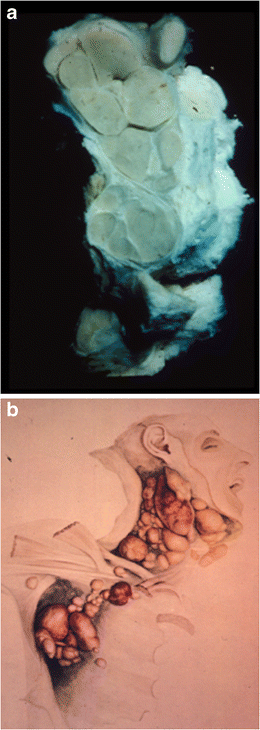
a A specimen from the Gordon Museum, Guy’s Hospital of one of the original Hodgkin lymphoma cases described by Hodgkin.


b Water-color drawing by Robert Carswell of case VII . Both images show well the discrete abnormal nodes in contrast to the usual picture of non-Hodgkin lymphoma where nodes are matted together 
(da Geller et al, 2013)

domenica 21 luglio 2013

Talking to patients about a diagnosis of malignancy in a FNA clinic setting

Informing patients of a cancer diagnosis is never easy and requires skills not systematically taught in US medical schools and residency programs. The absence of a universally accepted best method for delivering bad news presents an additional challenge. In specialties like pathology, practitioners typically have little patient contact. Training programs, including Cytopathology fellowships, in which patient encounters are routine during fine-needle aspiration (FNA) procedures, offer minimal education on this topic. Formal teaching in this area is lacking, even in medical fields where physicians frequently must present bad news to patients, such as palliative care and oncology.Without adequate training, delivering bad news to patients is made more difficult for physicians in all fields, and the FNA pathologist in particular may be reluctant to participate in patient care beyond obtaining the FNA sample. [...]

Pathologists are integral members of the clinical team, and cytopathologists in particular need to develop communication skills for discussing disease with patients. Deciding whether and how much to tell a patient about the FNA diagnosis is subject to personal judgment and the unique interaction between a patient and pathologist.

Ly, A. (2013), Talking to patients about a diagnosis of malignancy in a fine-needle aspiration clinic setting. Cancer Cytopathology, 121: 339–340. 


lunedì 17 giugno 2013

Follicular dendritic cells: origin, function, and different disease-associated patterns

Follicular dendritic cells (FDCs) are a specialized type of antigen-presenting dendritic cells that are largely restricted to lymphoid follicles. They form dense three-dimensional meshwork patterns within benign follicles, which maintain the follicular architecture. The FDC function is to bind and retain antigens by linking to complement and immune complexes and then present these antigens to germinal center B cells that start the secondary immune response. FDCs aid in the rescue of bound B cells from apoptosis, and induce the differentiation of B cells into long-term memory B cell clones or plasma cells. We will discuss the different patterns of the FDC meshwork observed in different types of reactive and neoplastic disorders, which may be due to underlying different roles that FDCs may play in these disorders and whether changes in the architecture of the FDC meshwork can be useful in routine diagnostic practice or have a prognostic value.
Rezk SA, Nathwani BN, Zhao X, Weiss LM. Follicular dendritic cells: origin,function, and different disease-associated patterns. Hum Pathol. 2013Jun;44(6):937-50.


FDC patterns in reactive and neoplastic disorders highlighted by CD21 immunostaining, from Rezk et al, 2013.

lunedì 3 giugno 2013

A brief chronicle of clinical cytology

Posto un breve excursus sulla storia della citologia clinica apparso recentemente su Diagnostic Cytopathology. Per chi volesse approfondire l' argomento, consiglio l' ottimo libro di Grunze e Spriggs corredato da uno splendido apparato iconografico.

Hampeln, in 1887, published the first case of primary squamous cell carcinoma of the lung and pleura with an illustration of a drawing of cancer cells

(Hampeln P. Über einen Fall von primären Lungen-Pleura-Carinom. St. Petersburg med Wohenschr 1887; 12: 137.)


Bibliografia.


Grunze, H. and A. I. Spriggs (1983). History of clinical cytology: a selection of documents, G-I-T Verlag E. Giebeler.

mercoledì 22 maggio 2013

NIH Director's Wednesday Afternoon Lectures

Dal canale di Youtube del National Institutes of Health, i video dei Seminari del Mercoledì sui più vari aspetti delle scienze biomediche.

The NIH Director's Wednesday Afternoon Lecture Series includes weekly scientific talks by some of the top researchers in the biomedical sciences worldwide.

NIH Youtube Channel (link).

(segnalato dal dr. F. Merolla).


giovedì 9 maggio 2013

Cancer genome landscapes

Over the past decade, comprehensive sequencing efforts have revealed the genomic landscapes of common forms of human cancer. For most cancer types, this landscape consists of a small number of "mountains" (genes altered in a high percentage of tumors) and a much larger number of "hills" (genes altered infrequently). [...] A typical tumor contains two to eight of these "driver gene" mutations; the remaining mutations are passengers that confer no selective growth advantage. Driver genes can be classified into 12 signaling pathways that regulate three core cellular processes: cell fate, cell survival, and genome maintenance. A better understanding of these pathways is one of the most pressing needs in basic cancer research. Even now, however, our knowledge of cancer genomes is sufficient to guide the development of more effective approaches for reducing cancer morbidity and mortality.


(segnalato dal prof. G. Troncone)

Salvador Dalì. Árabes aciddesoxiribonucleics, Paisaje de mariposa. El gran masturbador en paisaje surrealista con ADN.

sabato 4 maggio 2013

Hypoxic Patterns of Placental Injury

The placenta does not respond in a single way to hypoxia, and various placental hypoxic features should be explained within a clinical context. Because the placenta has a large reserve capacity, hypoxic lesions may not result in poor fetal condition or outcome. On the other hand, very acute, in utero, hypoxic events, followed by prompt delivery, may not be associated with placental pathology, and many poor perinatal outcomes can be explained by an etiology other than hypoxia. Nevertheless, assessment of placental hypoxic lesions is helpful for retrospective explanations of complications in pregnancy and in medicolegal investigation.

Histopathologic features of placental hypoxia da Stanek J. 2013

Stanek J. Hypoxic patterns of placental injury: a review. Arch Pathol Lab Med.2013 May;137(5):706-20.